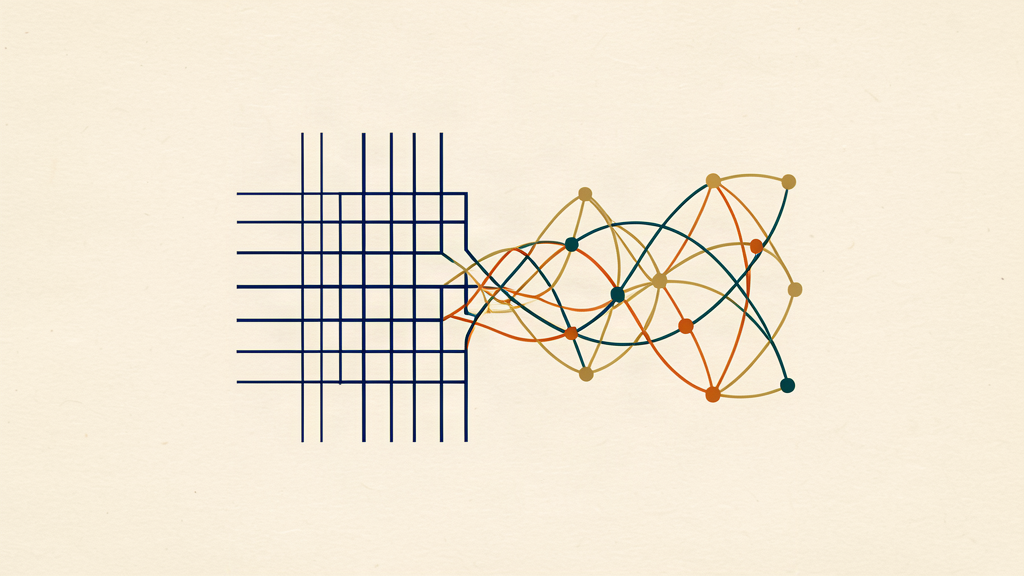
Most leadership frameworks were built for a world that no longer exists.
The models we still teach in MBA programmes, still embed in performance reviews, and still use to structure our organisations were designed for predictable environments. Linear cause and effect. Command and control. Five-year strategic plans drawn on static whiteboards. The assumption that the future can be mapped in advance and executed against a fixed roadmap.
That world is gone.
What replaced it is harder to name, which is why most organisations are struggling to adapt to it. The pace of technological change has outstripped the pace of organisational adaptation. Geopolitical fragmentation, declining institutional trust, and resource constraints are colliding with accelerating AI adoption — all at once, all entangled, all feeding back into each other.
I call it the Quantum Storm. Not because it sounds dramatic, but because the physics is apt: in a quantum system, nothing moves in a straight line. Everything is connected to everything else. Change one variable and the whole field shifts. Predictability breaks down. What worked yesterday does not work today, and what works today will not work tomorrow.
The UK’s productivity figures tell the story. Recent research shows that 82% of managers are “accidental” — placed into leadership roles because they were strong individual contributors, not because they were trained to lead. Engagement is declining. Trust in institutions is eroding. The operating system underneath most of our leadership practice was built for a world of lines, and we are now living in a world of loops.
We keep trying to solve the problem with more of the same. More planning. More process. More control. More tools. And the storm keeps accelerating.
Here is the question that started my research: what if the problem is not that we lack new frameworks, but that we abandoned the ones that actually describe how complex systems work?
Before the industrial age, before the scientific revolution, before Drucker, before Kahneman, there was a body of thought that described a universe governed not by static control but by dynamic, interlocking laws. It was called Hermeticism, attributed to Hermes Trismegistus — Thoth in Egypt, Hermes in Greece. The teachings were passed orally for thousands of years and compiled in 1908 into a short, dense book called The Kybalion. At its core are seven principles. Seven axioms that describe how reality operates when nothing is static:
1. Mentalism — the universe is mental; the mind is the first system
2. Correspondence — patterns repeat across scales; as above, so below
3. Vibration — nothing rests; everything moves
4. Polarity — everything has poles; opposites are the same thing in different degrees
5. Rhythm — everything swings; the pendulum always returns
6. Cause and Effect — nothing merely happens; every condition has a traceable cause
7. Gender — creation requires the dynamic balance of organising and generative principles
These are not mystical platitudes. Read carefully, they describe a physics of leadership — a set of laws that govern how organisations, teams, and individuals behave when the environment is not stable but dynamic, entangled, and accelerating.
The Kybalion calls the application of these principles Mental Transmutation — the art of changing conditions by changing states. Not passive philosophy. An operational discipline:
“If the Universe is Mental in its nature, then Mental Transmutation must be the art of changing the conditions of the universe, along the lines of Matter, Force and mind.”
Change the state. Change the conditions. That is the entire Hermetic proposition in one sentence.
Now here is where it gets interesting for anyone leading in the Quantum Storm.
Modern neuroscience has spent a century confirming what the Hermeticists asserted five thousand years ago. Daniel Kahneman’s System 1 (fast, automatic, reactive) and System 2 (slow, deliberate, reflective) describe the same distinction the Kybalion makes between using mental laws haphazardly and applying them intelligently. The leader who has not audited their own cognitive defaults does not lead. They are led — by patterns they did not choose.
Spiral Dynamics describes the same trajectory the Kybalion maps with Vibration and Polarity: organisations move through developmental stages, from rigid order (Blue) through achievement and extraction (Orange) and consensus (Green) to systemic integration (Yellow). Each stage vibrates faster than the last. The leaders who survive are not the ones who hold the most knowledge. They are the ones whose rate of learning matches the rate of change.
Systems theory confirms the Principle of Correspondence: patterns repeat across scales. The leader’s internal state mirrors the team’s experience. The team’s dynamics mirror the organisation’s culture. The organisation’s behaviour mirrors the leader’s cognitive defaults. When the pattern at the top is incoherent, the pattern throughout is incoherent. As above, so below.
And the Principle of Cause and Effect is the oldest statement of what we now call systems thinking: nothing merely happens. Every culture of silence, every failed handoff, every disengaged team is an effect with a traceable cause. The 82% accidental manager crisis is not bad luck. It is law — the inevitable effect of promoting Stage 2 specialists into Stage 3 and 4 roles without training, mindset shift, or structural support.
So why does this matter for you, as a leader, right now?
Because most of what you are dealing with — the execution drag, the trust gaps, the strategy that looks perfect on paper and dissolves on contact with reality — is not a set of isolated problems. It is a system behaving according to laws you may not have been taught.
The Hermetic Principles are not a belief system. They are a diagnostic framework. They describe the underlying physics of the conditions you are standing inside. And once you can see the laws, you can work with them instead of against them.
That is what my SyncShift Model was built to do. It takes the dynamics these principles describe and makes them measurable — across six dimensions of leadership intent and stakeholder impact. The gap between what you believe you are projecting and what your team is actually experiencing is not a soft cultural issue. It is the most expensive line item in your organisation, and it is measurable.
Over the next seven posts, I will take each Hermetic Principle and show how it maps directly onto a dimension of the SyncShift framework. Each post will be practical, not philosophical. The aim is not to teach you ancient wisdom. The aim is to give you a set of lenses that make the invisible dynamics in your organisation visible — and actionable.
The Kybalion says: “He who knows these, understandingly, possesses the Magic Key before whose touch all the Doors of the Temple fly open.”
The doors of the Quantum Storm do not open with certainty. They open with coherence. And coherence begins with understanding the laws that govern the system you are standing inside.
The future no longer rewards certainty. It rewards coherence.
This is the introduction to a seven-part series: The Hermetic SyncShift. Next: Mentalism — why the leader’s mind is the first operating system. #RidingTheQuantumStorm #HermeticPrinciples #Kybalion #SyncShift #QuantumLeadership #Coherence #LeadershipDevelopment #FutureOfWork #SystemsThinking #OrganisationalCulture #ManagementThinking #Leadership
Leave a Reply